
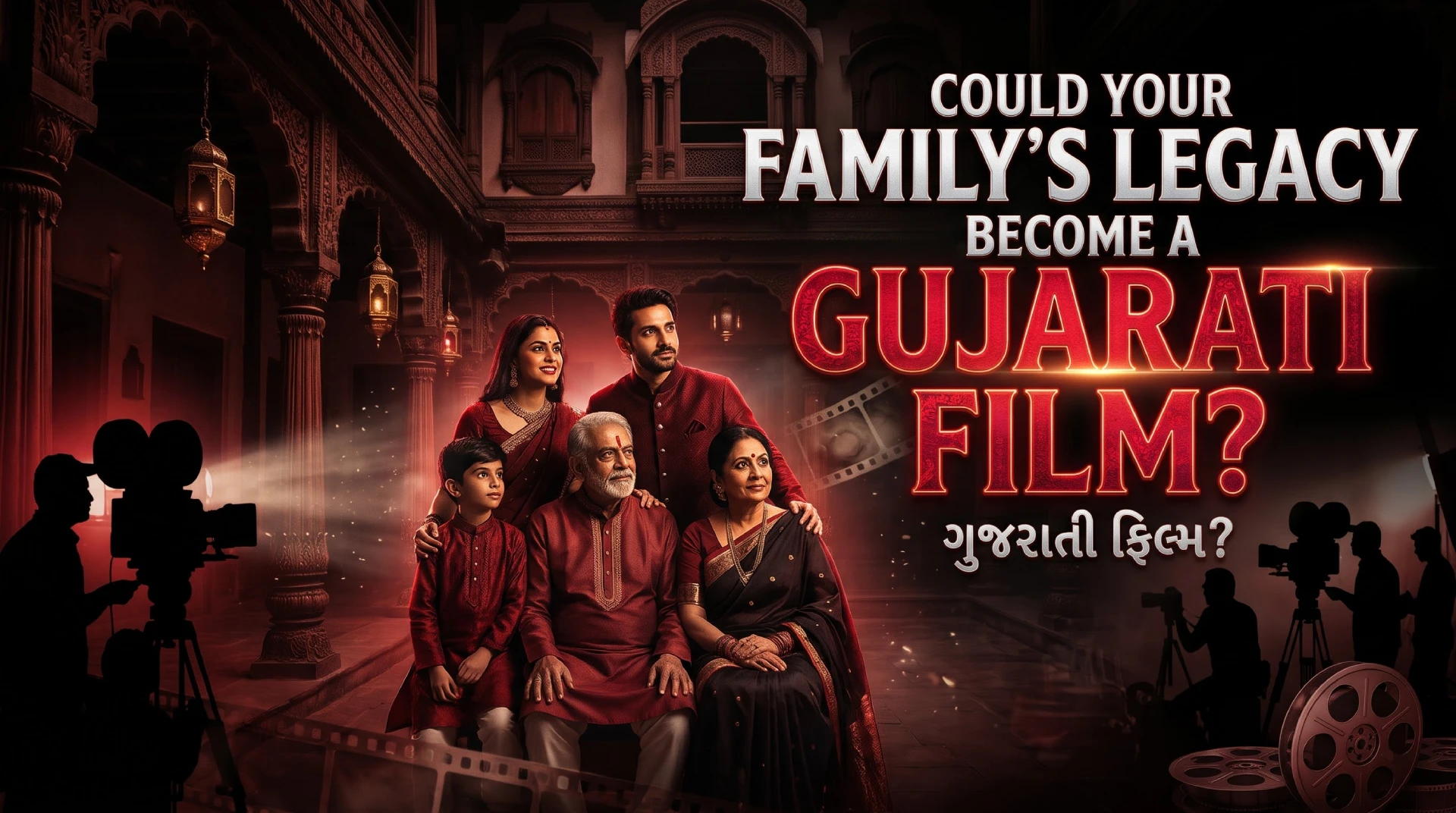
Every successful family has a story.
Some families built businesses from nothing. Some contributed to their communities. Others have a history of courage, leadership, social service or entrepreneurship that has been passed down through generations.
But how many of these stories are actually known beyond the family?
What if a story connected to your family, your ancestors or your community could become a Gujarati film?
For established Gujarati business families, NRIs and entrepreneurs, this is an interesting possibility to explore.
A film can take a story beyond personal memories and introduce it to a much wider audience.
Every Family Has a Story, But Some Stories Deserve a Bigger Audience
Across Gujarat and the Gujarati diaspora, there are families with fascinating histories.
Consider the possibilities:
- A business family that built an enterprise over several generations.
- An ancestor who made an extraordinary contribution to society.
- A family connected with an important historical event.
- A community personality whose achievements are not widely documented.
- A story of migration, struggle and building a new life abroad.
- A family tradition that has survived across generations.
Some of these stories could inspire a documentary. Others may have the depth and dramatic potential for a feature film.
The first step is identifying the story and understanding whether it can be developed into a credible cinematic project.
Why Are Gujarati Families Exploring Cinema?
Gujarati cinema is a platform through which stories connected to Gujarat, its people and its culture can reach audiences.
For some families, the attraction may be cultural. For others, it may be the opportunity to participate in a creative business project.
A film associated with a family’s history can potentially:
- Introduce an important family story to a wider audience.
- Preserve memories and historical accounts through research and filmmaking.
- Create awareness about a personality or contribution.
- Connect younger generations with their roots.
- Build a meaningful association with Gujarati cinema.
However, a film should not be treated as a guaranteed way to establish a family’s legacy. The quality, authenticity and audience relevance of the story remain essential.
What Kind of Family Stories Can Become Films?
Not every family history needs to become a movie. The story must have a strong narrative foundation.
Here are a few possibilities.
1. A Family’s Journey of Building a Business
Many Gujarati business families have remarkable stories of entrepreneurship.
A story may begin with a small shop, a modest manufacturing unit or a business started by an individual with limited resources.
Over time, the family may have expanded into multiple industries or international markets.
With the right research and storytelling, such a journey could become an inspiring business-based film.
2. A Historical Personality Connected to Your Family
Some families preserve documents, photographs, letters and accounts about personalities from earlier generations.
These materials may provide useful starting points for researching a historical subject.
The information should be independently verified through reliable historical sources and relevant experts before it is adapted into a screenplay.
3. A Community’s Contribution to Gujarat
Some stories belong not just to one family but to an entire community.
They may involve social reformers, freedom fighters, philanthropists, saints, leaders or individuals who contributed significantly to society.
A film can explore such a subject while respecting the historical record and the people connected to it.
4. The Journey of Gujaratis Abroad
The migration stories of Gujarati families can also offer strong cinematic possibilities.
Leaving India, building a business in another country, facing challenges and maintaining a connection with Gujarat can create an emotionally engaging narrative.
Such stories may connect with audiences in India and overseas.
Can a Family Become a Film Producer?
Yes. A family or an individual entrepreneur can explore becoming a producer or co-producer of a Gujarati film.
You do not necessarily need an existing film production company or an entertainment industry background.
Depending on the project, you can explore different forms of participation:
Producer: Participate in the overall development, financing and execution of the film according to the agreed production structure.
Co-Producer: Join an existing production arrangement with clearly defined financial and production responsibilities.
Project Partner: Participate in a specific creative or production arrangement, subject to the rights and responsibilities defined in writing.
Documentary Patron: Support the development of a documentary or heritage-focused project based on an agreed scope and funding structure.
Each arrangement requires a clear agreement. Financial contributions, credits, intellectual property rights, approvals and revenue-sharing terms should be documented before work begins.
What Should You Prepare Before Approaching a Production House?
If your family has a story that you believe deserves to be told, begin by collecting the available information.
Useful material may include:
- A short introduction to the family or personality.
- Historical photographs and documents.
- Important dates and events.
- Family records and written accounts.
- Interviews with senior family members.
- References to books, archives or historical sources.
- Information about permissions and rights.
A production team can then assess whether the material is suitable for a documentary, biographical film or feature-length Gujarati movie.
The availability of source material does not automatically establish historical accuracy or adaptation rights. These matters should be reviewed separately.
What Is the Budget for a Family-Based Gujarati Film?
The budget depends on the format and scale.
A documentary about a family or personality may require a different production budget from a large-scale historical feature film.
A feature film may involve screenplay development, casting, locations, sets, costumes, shooting, post-production and marketing.
At AK Films Production, proposed Gujarati feature film projects may start around ₹3 crore, depending on the project’s requirements. This is an indicative starting point, not a fixed price.
A detailed project budget should be prepared after evaluating the story, format, production scale and intended audience.
How AK Films Production Can Help Explore Your Story
AK Films Production is interested in developing Gujarati films based on historical personalities, cultural subjects, biographies and original stories.
We welcome discussions with Gujarati business families, NRI entrepreneurs and individuals who have a story connected to Gujarat that they would like to explore for cinema.
The process can begin with understanding the story, reviewing available information and assessing its cinematic potential.
Depending on the subject, the next steps may include research, screenplay development, production planning, budgeting and discussions about a suitable producer or co-producer arrangement.
Explore our services and opportunities:
- Gujarati Film Investment Opportunities in India and Worldwide
- Invest in Gujarati Films with AK Films Production
- Become a Gujarati Film Producer
Your Family’s Story Could Be the Beginning of a Film
A family legacy is usually preserved through photographs, documents, memories and conversations.
But some stories have the potential to reach beyond the family and connect with a much larger audience.
If you have a family history, an ancestor’s journey or a community story that deserves serious exploration, Gujarati cinema could be one way to bring it to life.
Have you ever thought about turning your family’s story into a Gujarati film?
Start by exploring its historical background, cinematic potential and production requirements with AK Films Production.
Any film project or financial participation would be subject to research, feasibility, due diligence and a mutually agreed written arrangement.
Frequently Asked Questions
1. Can I make a Gujarati film based on my family history?
Yes. A family history may be explored for a documentary or feature film if the story has sufficient material and cinematic potential. Historical accuracy, permissions and adaptation rights should be reviewed.
2. Can a business family become a Gujarati film producer?
Yes. A business family can explore producer or co-producer participation through a suitable production arrangement with clearly defined responsibilities and written agreements.
3. Can NRIs produce a film based on their family’s story in Gujarat?
NRIs can explore such projects, subject to applicable Indian laws, foreign exchange regulations, tax requirements and the legal structure of participation.
4. What documents are required to develop a family-based film?
Useful materials include photographs, historical documents, family records, interviews, written accounts and references to reliable historical sources. The required material depends on the subject.
5. How much does it cost to make a Gujarati family-based film?
The cost depends on whether the project is a documentary or feature film, its duration, production scale, locations, cast and technical requirements. A project-specific budget is necessary.
6. Can AK Films Production develop a film based on our family’s story?
You can approach AK Films Production to discuss the story, available research material, format, development requirements and possible production arrangements. Acceptance and development depend on project evaluation.
7. Does producing a Gujarati film guarantee financial returns?
No. Film production involves financial and commercial risks. Neither box-office performance nor a financial return can be guaranteed. Every project should be evaluated independently before participation.


